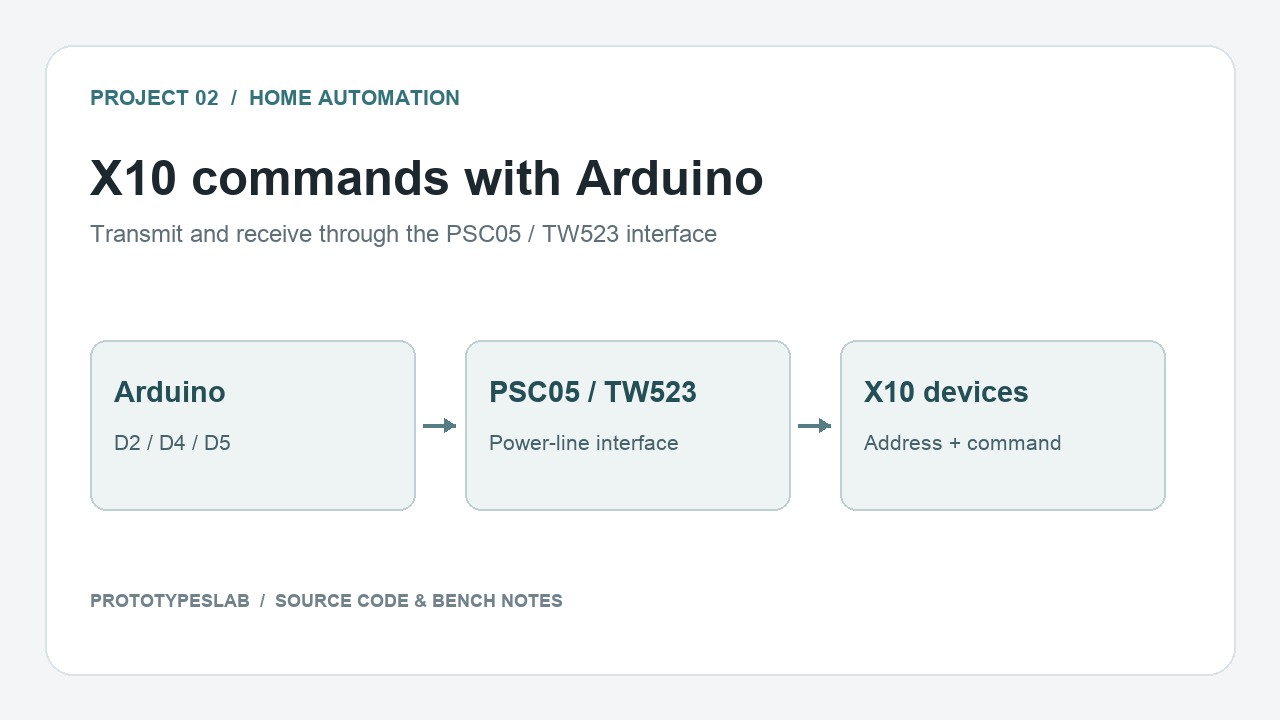
This project explores sending and receiving X10 commands through a power-line interface. Two sketches separate a repeating transmitter demonstration from a receiver that interprets incoming commands and sends a response. The accompanying protocol document provides the background for the interface signals and message format.
How the project works
The transmitter addresses house A, unit 2, then cycles through ON, four BRIGHT commands, four DIM commands and OFF. One-second delays make the sequence easy to follow. The repeated transmission setting is 2.
The transmitter/receiver sketch attaches an interrupt to the zero-crossing input and assembles received data into X10 frames. Its application logic checks for unit 5 and sends commands to house P, unit 5. These addresses are choices in this example, rather than a general home-automation configuration.
Hardware and configuration
| Item | In the supplied code |
|---|---|
| Transmit signal | Arduino D5 |
| Receive signal | Arduino D4 |
| Zero-crossing input | D2 / external interrupt 0 |
| Serial monitor | 9600 baud |
Working with the supplied code
Open the transmitter first to understand the command sequence, then compare the receiver version. Both depend on the x10 library and its constants. The comments describe timing for a 60 Hz system, so review that assumption before adapting the code.
Use the documented low-voltage interface of the PSC05/TW523. The protocol PDF is the reference for connector orientation and timing; this post does not replace the interface’s electrical documentation. Reception is temporarily detached during transmissions, and blocking delays make this a demonstration rather than a robust message queue.
Video demonstration
Source code and project files
Browse this project on GitHub. The files below are useful starting points for the sketches and references discussed in this post.
- X1_PSC05_TW523_Transmiter/X1_PSC05_TW523_Transmiter.ino
- X1_PSC05_TW523_Transmiter_Receiver/X1_PSC05_TW523_Transmiter_Receiver.ino
- X-10-Communications-Protocol-PSC05.pdf
Download the used libraries (ZIP, 14.7 MB).
These notes describe the archived source and project media. The sketches have not been rebuilt or tested on hardware for this article.